Please don't hesitate to reach out to us whenever you need assistanco. Well make sure to respond to you promptly.
 lyang_huang@gadetin.com.cn
gadetin@gadetin.com.cn
lyang_huang@gadetin.com.cn
gadetin@gadetin.com.cn +86 136 7623 8313
 +86 153 3806 1804
 09:00 - 18:00
 No.2 Zhenglong 1st street, Dawang National Hi-tech Developmet Zone, Zhaoqing City, Guangdong, China
Launching a competitive beauty or skincare brand in today's global market requires more than just a strong marketing strategy; it requires a robust, agile, and reliable supply chain. For emerging brands, retailers, and distributors, building an in-house production facility involves prohibitive capital expenditure and operational risks. The solution lies in outsourcing, but not all contract manufacturers are created equal. This technical guide explains how selecting a full-service personal care OEM manufacturer reduces development risks by providing integrated solutions from R&D and custom formulation to packaging and export-ready mass production.
The Strategic Role of a Full-Service Personal Care OEM Manufacturer
Technical Capabilities: Evaluating an OEM ODM Cosmetic Manufacturer
Basic Contract Manufacturing vs. Full-Service OEM: A Comparative Analysis
Overcoming Regional Market Challenges with Custom Formulation
Mitigating Quality Risks in Private Label Personal Care Manufacturing
The 5-Step Decision Framework for Selecting Your Manufacturing Partner
A full-service personal care OEM manufacturer acts as an extension of a brand's internal team because it consolidates formulation R&D, raw material sourcing, packaging design, and commercial manufacturing into a single, streamlined process.
In emerging markets across Southeast Asia, Eurasia, the Middle East, and Africa, buyers frequently struggle with limited in-house chemical engineering capabilities, complex regulatory compliance, and the high cost of managing multiple disparate vendors. A true full-service partner eliminates these bottlenecks. By leveraging an established manufacturing infrastructure, brands can shift their focus entirely to marketing, sales channel development, and distribution. The primary advantage here is the drastic reduction in time-to-market. Instead of spending 12 to 18 months building a supply chain from scratch, brands can launch custom products in a fraction of the time.
Evaluating an OEM ODM cosmetic manufacturer requires assessing their R&D laboratory infrastructure, ingredient library depth, and cross-category manufacturing versatility across skincare, haircare, and body care.
To support true B2B scalability, the manufacturer must demonstrate profound technical competence in the following areas:
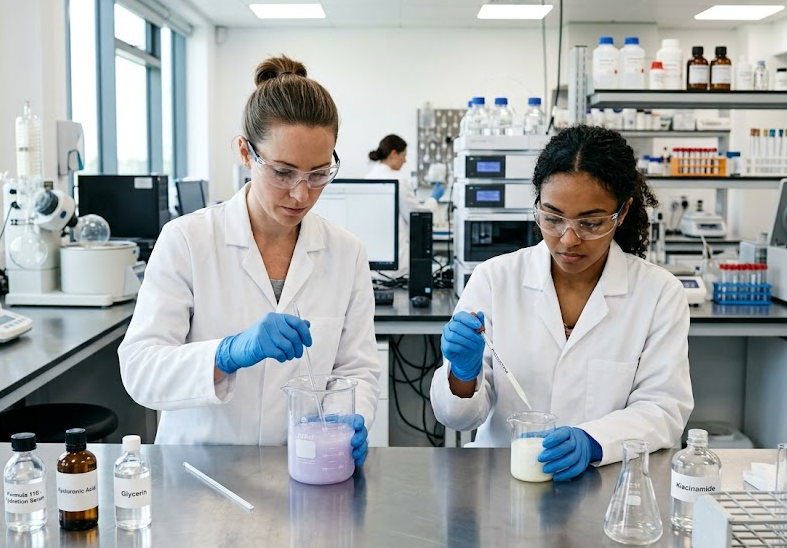
A competent custom formulation manufacturer does not simply mix provided ingredients; they engineer solutions. This includes developing custom formulations from scratch, optimizing existing formulas for better stability, and assisting with the selection of active ingredients that align with the brand's target claims. They must understand surfactant chemistry for cleansers, emulsion stability for lotions, and rheology modifiers for serums.
Consolidating procurement with a single supplier reduces logistical complexity. An ideal partner should possess the equipment and regulatory clearance to manufacture across multiple categories:
Skincare: Facial cleansers, specialized serums, high-viscosity creams, lightweight lotions, and mask formulations.
Hair Care: Sulfate-free shampoos, deeply nourishing conditioners, and targeted scalp treatments.
Body Care: Body washes, exfoliating scrubs, and barrier-repairing body lotions.
Extended Categories: Baby care (requiring hypoallergenic standards), men's grooming, oral care, pet care, and household care.
By covering these bases, a beauty product manufacturing partner ensures that as a retailer's private label product line expands, the supply chain remains unified.
Full-service OEM manufacturing is preferred for emerging brands and expanding retailers because it simplifies supply chain management and reduces overhead, whereas basic contract manufacturing is strictly suitable for established corporations with internal R&D, procurement, and regulatory teams.
Understanding the difference between simply hiring a factory to fill bottles and partnering with a full-service provider is critical for procurement teams to make informed decisions.
Custom formulation manufacturers are highly effective for global expansion because they can adjust product textures, active ingredient concentrations, and compliance documentation to meet specific regional environmental conditions and localized consumer preferences.
A one-size-fits-all formula rarely succeeds globally. An experienced manufacturer analyzes environmental factors and cultural preferences to engineer specific solutions:
Products destined for tropical, hot, and humid climates require specific rheological properties. Formulas must focus on lightweight, non-comedogenic textures, fast absorption, and effective sebum control. A heavy occlusive cream designed for European winters will fail here; instead, gel-based moisturizers and water-light serums are necessary.
This market demands premium positioning and resilience against arid environments. Skincare formulations require high concentrations of humectants and powerful occlusives for long-lasting hydration. Additionally, manufacturers must be adept at sourcing ingredients that meet strict regional compliance and cultural expectations, such as halal-certified raw materials.
The focus here is often on high-efficacy, affordable personal care solutions. Formulations must balance robust active ingredients with cost-effective base materials. Furthermore, the products must possess exceptional thermal stability to withstand varying logistics and storage conditions without phase separation. Working with an expert in custom formulation development ensures these regional nuances are built directly into the product blueprint.
Quality risks in private label personal care manufacturing are mitigated through strict adherence to GMP standards, comprehensive physical stability protocols, and rigorous microbiological testing before mass production.
A product recall due to contamination or phase separation can destroy a brand's reputation. To prevent this, a credible skincare OEM manufacturer implements multi-tiered quality control systems:
GMP Compliance: Manufacturing processes must strictly adhere to Good Manufacturing Practices, ensuring a sanitized environment, calibrated equipment, and traceable raw material batching.
Stability Testing: Formulas must undergo accelerated thermal testing, freeze-thaw cycles, and UV exposure tests to guarantee a reliable shelf life (typically 24 to 36 months) without changes in color, odor, or viscosity.
Microbiological Control: Preservative efficacy testing (PET) and routine microbial plate counts are mandatory to ensure products remain safe against bacterial and fungal growth during consumer use.
Packaging Compatibility: Formulations must be tested against their chosen primary packaging to prevent leaching, container collapse, or pump blockages.
Selecting a beauty product manufacturing partner requires a structured evaluation of their R&D capabilities, category coverage, quality certifications, production scalability, and export compliance expertise to ensure long-term commercial viability.
When evaluating potential suppliers, B2B buyers should follow this logical framework:
Evaluate the R&D Infrastructure: Do they offer a comprehensive formula library for quick white-label launches, alongside the capability for deep custom formulation?
Assess Category Breadth: Can they scale from basic facial cleansers to advanced hair treatments and baby care? Consolidating SKUs under one roof simplifies management.
Verify Quality Systems: Request their GMP certifications and inquire about their standard operating procedures (SOPs) for stability and microbiological testing.
Analyze Export Support: Do they understand the specific documentation required for your target market (e.g., PIF files, Certificates of Free Sale, Halal certifications)?
Review the Development Process: A professional partner should outline a clear milestone track: Concept Discussion -> Sample Development -> Packaging Approval -> Mass Production -> Export.
Partnering with a full-service personal care OEM manufacturer empowers brands to launch high-quality, regionally adapted beauty products rapidly while bypassing the massive capital expenditures associated with facility ownership. By selecting a partner with robust R&D, strict GMP compliance, and broad category coverage, brands can mitigate supply chain risks and focus on market expansion.
Whether you are a startup launching a new skincare line in Southeast Asia, or a global retailer expanding a private label body care collection, the key to success is leveraging the technical expertise of an integrated manufacturing partner.
Ready to bring your cosmetic concepts to life?
For brands looking for a strategic partner who can handle product ideas, formula development, mass manufacturing, and market launch preparation, expert support is available. Contact Gadetin Group to request a technical consultation, discuss your custom formulation requirements, or initiate a product sampling phase for your next OEM/ODM project.
What is the difference between an OEM and an ODM in personal care?
OEM (Original Equipment Manufacturer) typically refers to a manufacturer producing goods based on your exact specifications and formulas. ODM (Original Design Manufacturer) provides full-service solutions, including supplying pre-developed, tested formulas that can be customized and branded as your own.
How long does it take to develop a custom personal care formulation?
Custom formulation typically takes between 3 to 6 months. This timeline accounts for R&D benchwork, physical stability testing, microbiological testing, and packaging compatibility checks to ensure safety and performance.
Can a skincare OEM manufacturer help with packaging selection?
Yes. A full-service manufacturer maintains extensive networks of packaging suppliers. They assist in selecting bottles, pumps, and jars that not only match your brand aesthetic but also demonstrate chemical compatibility with the product formula.
Why is stability testing critical for beauty product manufacturing?
Stability testing ensures the product maintains its intended physical properties, chemical integrity, and safety throughout its shelf life under various environmental conditions, preventing costly recalls due to phase separation or spoilage.
How can emerging brands ensure compliance when entering new international markets?
Brands should partner with an OEM manufacturer experienced in international export. A capable partner will formulate products using globally compliant raw materials and assist in generating the necessary safety data sheets and regulatory documentation required by local authorities.

 English
 Français
 Русский язык
 español


